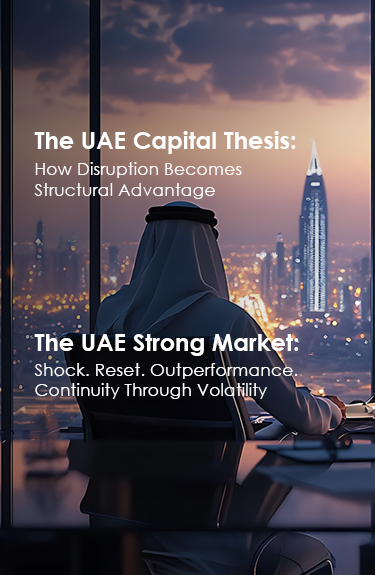
YOU MAY READ THIS THROUGH THE LENS OF CONFLICT OR HEADLINES. BUT THIS IS DIFFERENT.
Every cycle in the UAE presents the same decision point:
Hesitate - or - Position first. Not a market decision. A capital discipline the UAE has proven, cycle after cycle.
From operating within UAE market structures, one pattern becomes clear:
The UAE does not experience disruption in the same way most markets do.
It operates on a repeatable cycle:
Shock → Structural Reset → Accelerated Outperformance
The Cycle in Practice (2008–2024)
2008 — Global Financial Crisis System-wide contraction → regulatory maturity → diversification across trade, logistics, and finance.
2014–2016 — Oil Price Shock Regional liquidity tightening → non-oil sectors absorb impact → multi-sector growth resumes.
2020 — Pandemic Disruption Short-term retreat → rapid capital re-entry → AED 761B+ real estate transactions by 2024.
This pattern is not sector-specific.
It spans: real estate I logistics I aviation I tourism I fintech I trade
This is not resilience. It is system design.
Why Most External Narratives Misread the UAE?
The UAE is often interpreted through surface signals:
Luxury I Volatility I Lifestyle performance. I Beauty Standards I Visitors I Tall Buildings I Supercars ….etc.
Serious capital does not allocate based on optics. It evaluates underlying architecture:
1- Regulatory evolution across emirates
2- Institutional frameworks (DIFC, ADGM, DMCC) enabling capital structuring and deployment
3- Long-term national planning (50-year economic frameworks (D33- D40) ) global connectivity infrastructure (trade corridors, aviation, logistics corridors) continuous inflow of capital and high-skill talent…etc.
These are not features. They are capital enablers.
UAE Stability Is Engineered, Not Assumed
No regional economy is immune to volatility. The differentiator is not avoidance. It is containment capacity.
Dubai and Abu Dhabi operate as a coordinated system with:
Strategic economic balance policy alignment across sectors diplomatic positioning security containment and perception management. This creates a market environment where:
Disruption does not break the system. It resets positioning within it.
What Institutional Capital Actually Prices?
Surface-level incentives are visible:
1.Tax efficiency
2.Golden Visa frameworks
3.Infrastructure quality
But institutional capital allocates based on something deeper:
Confidence in execution under pressure.
Confidence that:
1- Governance systems function through Hardships.
2- Regulatory frameworks adapt without friction.
3- Capital can enter, operate, and scale
economic coordination remains intact
4- Strong international affairs & Policies
Whether measured through:
1.Trade volumes
2.Logistics throughput
3.Real estate transactions
4.Capital inflows
The signal remains consistent: The system holds. The Strategic Investor Error
UAE GDP over the last 40 years (1985 – 2025)
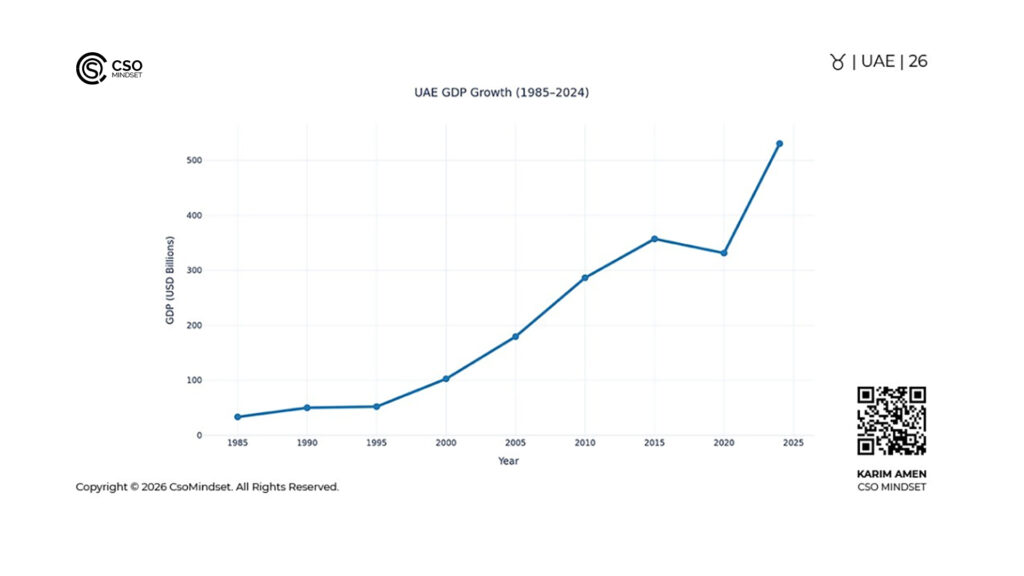
Using verified IMF/World Bank data.
What P&T (Pattern & Trend) you see?
The wrong question:
“Will there be volatility?”
Every serious economy cycles.
The correct question:
“Which markets convert volatility into structural advantage, consistently,
and across sectors?”
The UAE has answered this repeatedly.
Positioning Logic Across Cycles
Corrections are not signals to retreat.
They are structured entry windows.
Capital positioning typically concentrates on:
1.Prime real estate and logistics corridors
2.Institutional-grade assets
3.high-quality operators (developers, traders, logistics firms)
4.Long-term partnerships and capital structures
The advantage is not access.
It is timing within a predictable system.
The UAE Investment Thesis
1.Markets fluctuate.
2.Narratives shift.
3.Headlines amplify risk.
But systems with:
1.Governance depth
2.Diversified economic foundations (non-oil GDP >74%)
3.Global capital relevance
4.Sustained inflows of capital and talent
Do not weaken under pressure. They:
1.Reset
2.Restructure
3.and outperform
Conclusion
In every cycle, the same divide appears:
Those who interpret volatility as risk, and those who recognize it as reallocation.
In the UAE: Volatility does not eliminate opportunity. It reallocates it.
Simply Put: It’s like musical chairs. When the music stops, only those who moved right will still have a place.
The only question is:
Who positions early enough to capture it.
Karim Amen 🇦🇪
Chief Strategy Officer I 20+ Years Experience I Growth Architect I B2B Markets I OPS-BD-SM I Branding & Marketing Director I M.S. Leadership & Sustainability I Driving Multi-Sector Business Cluster I Beyond Success
#InstitutionalInvestors #GCCBusiness #EconomicDevelopment #UAEEconomy #DubaiEconomy #AbuDhabiEconomy #GCCPolicy #MiddleEastEconomy #SovereignWealth #CapitalMarkets #InvestmentStrategy #ForeignDirectInvestment #ExecutiveLeadership #StrategicThinking #MarketStrategy #EconomicResilience #LongTermInvesting #GlobalInvesting #UAEGovernment #UAEEconomy #DubaiEconomy #AbuDhabiEconomy #GCCPolicy #PublicPolicy #EconomicPolicy #NationalStrategy #EconomicDevelopment #GovernmentStrategy #SovereignWealth #InstitutionalInvestors #CapitalMarkets #EconomicResilience #GlobalEconomy