Most conversations about AI begin with productivity. They’re asking the wrong question. The greatest transformation of this era is not happening inside our organizations.
It is happening inside our nervous systems.
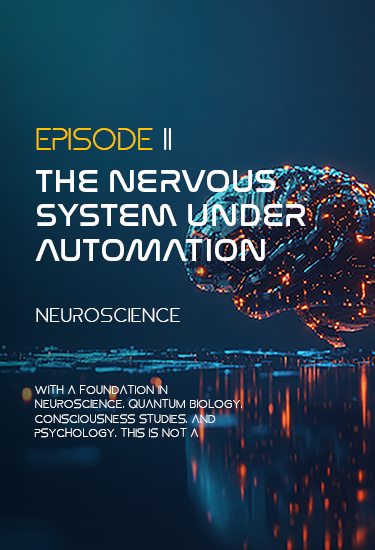
EPISODE HEADLINES:
1- The Original Design
2- The Adaptation Nobody Is Discussing
3- The High Performer’s Crisis
4- The Reward System Rewrite
5- The Choice That Defines This Generation
The Original Design
For thousands of years, the human brain was sculpted by a single relentless principle:
Effort creates adaptation.
We became who we are through struggle. Through problems that had no shortcuts. Through uncertainty we were forced to sit inside long enough to understand. Through nights of thinking that outlasted our comfort.
The brain didn’t just record our experiences. It was built by them.
Every decision navigated. Every complexity wrestled. Every question held without a premature answer, each one laid another layer of neural architecture.
This is how sapience was forged. Not downloaded. Not retrieved. Built: through the neuronal friction of effortful cognition.
The New Equation
Today, for the first time in the 300,000-year history of Homo sapiens, Intelligence itself has become available on demand.
Not stored within us. Available beside us.
And the architecture of the human brain, which evolved in a world of scarcity, delay, and difficulty, now operates inside a world of instant, frictionless cognitive assistance.
Every time we outsource a decision before attempting it ourselves. Every time we replace exploration with a prompt. Every time we choose the shortest cognitive path because the longer one feels unnecessary.
Our nervous system receives a quiet instruction.
Thinking is becoming optional. This is not a technological shift.
It is a biological one.
The Adaptation Nobody Is Discussing
The brain follows the same principle as every adaptive biological system:
What is repeatedly used becomes stronger. What is repeatedly bypassed quietly dissolves. This is not metaphor. This is neuroscience.
(use or lose it)
Neural pathways reinforced by habitual use become faster, denser, more automatic. Neural pathways deprived of use undergo synaptic pruning, the brain’s mechanism for eliminating what it has decided is no longer necessary.
The brain doesn’t know it’s outsourcing cognition to a machine. It only knows that certain cognitive efforts are no longer being demanded of it.
And so it begins to optimize, away from them. The result is subtle. Almost invisible in its early stages.
We become faster -> but less patient with complexity. More informed -> but less capable of independent reflection. More connected ->but less present inside our own thoughts. More productive -> but increasingly uncertain where our thinking ends and the machine’s begins.
The greatest irony of the intelligence era: The more cognitive power surrounds us, the less pressure there is to develop our own.
Check Out Our New Series NEURO WONDERS
The High Performer’s Crisis
For those who built careers on cognitive superiority, the disruption is not external. It is existential.
For decades, high performers constructed identity around three capabilities:
The ability to navigate complexity when others froze. The ability to create clarity where others saw only noise. The ability to outwork uncertainty through disciplined thought.
AI can now perform all three.
With astonishing speed. With no fatigue. With no ego, no bias, or at least, none that announces itself.
The question is no longer whether AI is capable. The question that now lives quietly in the mind of every high performer is this:
Who am I -> when my greatest strengths become commodities?
This is not a career question. It is a question of identity architecture.
And the nervous system -> whether we acknowledge it consciously or not -> is already responding.
The Quiet Reconfiguration
The adaptation doesn’t announce itself with collapse.
It arrives as a reorganization that, on the surface, looks like progress.
Execution gives way to supervision. Creation becomes curation. Exploration becomes verification. Curiosity begins requiring external activation.
Leaders celebrate this moment publicly.
“We finally have the space to think strategically.”
But strategy is not the product of empty calendars.
Strategy is the product of disciplined, sustained, our of the comfort zone “healthy cognition”, the kind the brain only produces when it has been regularly forced to operate without assistance.
I A mind that has stopped practicing depth cannot suddenly summon vision. Depth is not a mode you switch on. It is a capacity that either exists or doesn’t, built over years of deliberate, effortful thinking.
And something even more subtle begins to shift beneath the surface.
The Reward System Rewrite
Instant answers do not just solve problems. They reshape the architecture of reward.
Curiosity, in its original biological form, was designed to sustain effort across time. The reward was not the answer. The reward was the understanding earned through the process of finding it.
That delay, that discomfort, that sustained cognitive engagement, was the mechanism through which neural depth was built.
Now the answer arrives before the question has fully formed.
The brain begins to prefer answers over understanding. Resolution over exploration. Information over meaning.
“The dopamine once earned through discovery is now delivered through immediacy.”
Attention fragments. Reflection shortens. Tolerance for cognitive discomfort compresses.
Externally, everything appears optimized.
Internally, the architecture of agency, the felt sense that one’s thinking is one’s own, quietly begins to erode.
The Real Danger
The danger is not that AI will replace human intelligence. The danger is far more insidious.
It is that humans will gradually surrender the habits that produced intelligence in the first place, not through force, not through failure, but through the seductive comfort of never having to struggle cognitively again.
Automation will not take our thinking.
We will give it away, willingly, incrementally, almost imperceptibly, in exchange for speed, convenience, and the relief of cognitive ease.
The future will not belong to those who use AI the most.
It will belong to those who preserve the sovereign capacity to think independently while using it, who understand that the tool should amplify judgment, never replace it.
Because the greatest risk of the automation era is not losing our jobs.
It is losing the cognitive muscles that made meaningful work possible in the first place.
And a mind that has given away its capacity for depth, struggle, and sustained independent thought, cannot build those muscles back simply by switching the algorithm off.
The Choice That Defines This Generation
Every generation faces a defining question.
Ours is not whether to use AI.
It is whether we will use it while remaining cognitively sovereign, or whether we will allow it to create the most educated, most assisted, most intellectually comfortable generation of dependent thinkers in human history.
The tools are extraordinary.
The question is what we bring to them.
Technology should amplify judgment. Never replace it.
Because in the end, no algorithm can replicate what a human mind produces when it has been forged through genuine effort, genuine uncertainty, and the kind of sustained, uncomfortable thinking that built civilization to begin with.
Coming Up Next:
Episode III: What Cannot Be Automated When intelligence becomes abundant, what remains irreducibly human?
Karim Amen I CSO Mindset™ I Neuroscience I Quantum Mechanics | Business Growth Architect I Research & Development Lab I MEA I 2026 | www.CsoMindset.com
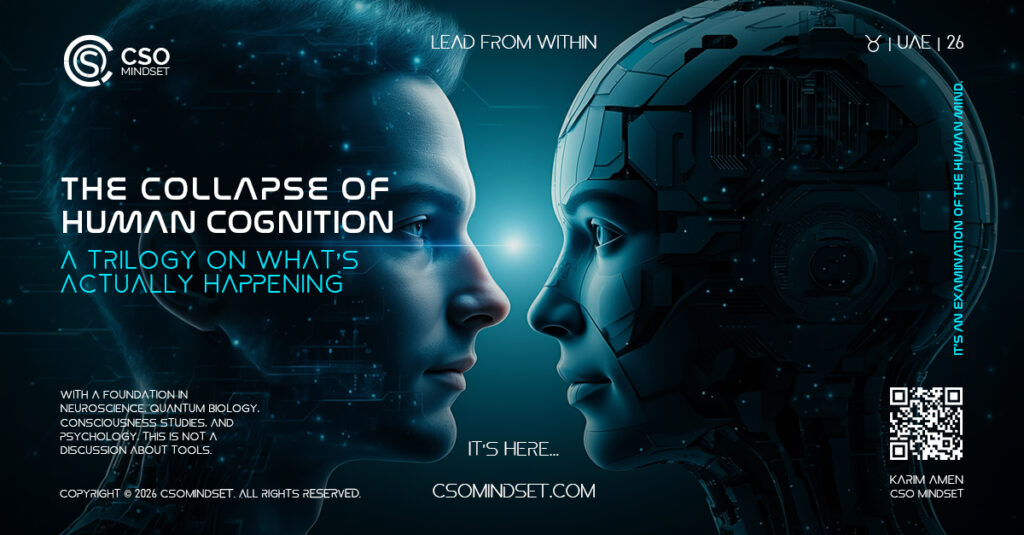
THE COLLAPSE OF HUMAN COGNITION
#neurosciencewonders #neuroscience #brainscience #Neurotechnology #braincomputerinterface #BCI #artificialintelligence #aigenerated #consciousness #CognitiveScience #neuroengineering #innovations #futuretechnology #science #technology #ArtificialIntelligence #FutureOfWork #ExecutiveLeadership #BusinessStrategy #AILeadership #StrategicThinking #HumanCognition #Neuroscience #DecisionMaking #BusinessTransformation #Innovation #Leadership #DigitalTransformation #ExecutiveEducation #BusinessArchitect #FutureOfThinking #GCCBusiness #DubaiBusiness #UAEBusiness #SaudiBusiness #CSOMindset #TheCollapseOfHumanCognition