
The Commodity Era Has Already Begun
We do not notice when a faculty atrophies, not at first. The hand that once navigated by stars now taps a screen. The mind that once held a thousand names now delegates to a contact list. Each outsourcing felt like progress. Each one quietly redrew the boundary of the self.
We are living that moment again, only this time, the faculty being outsourced is reasoning itself.
“Cognition is no longer purely human. It is a distributed mesh, brains, AI, and emerging quantum networks. Intelligence is now abundant. Agency, however, is becoming scarce.”
AI systems now draft our strategies, evaluate our options, synthesize our research, and schedule our attention. This is not a future scenario. It is Tuesday morning. And the risk is not that AI will replace human workers. The risk is far subtler: that we will voluntarily vacate the cognitive space we once occupied, and call it efficiency.
Intelligence as Infrastructure, and Why That Changes Everything
When electricity became infrastructure, it democratized light and power. It also made entire classes of skill structurally irrelevant overnight, the lamplighter, the ice merchant, the town crier.
Intelligence, packaged as a product, follows the same arc. The Commodity Era is characterized by a single dangerous dynamic: human memory and evaluation are being outsourced at scale.
Agentic AI does not simply answer questions. It executes sequences of decisions, booking, filtering, summarizing, prioritizing, across your professional and personal life without requiring your presence in the loop. The loop, in many cases, runs without you.
This is not malfunction. It is the design.
And when the loop runs without you long enough, something structural happens: the muscle of independent judgment softens. Strategic atrophy sets in, not dramatically, but the way a river silently changes course.
“The edge is not access to intelligence. Everyone has access. The edge is authorship, the capacity to define the problem before the machine solves it.”
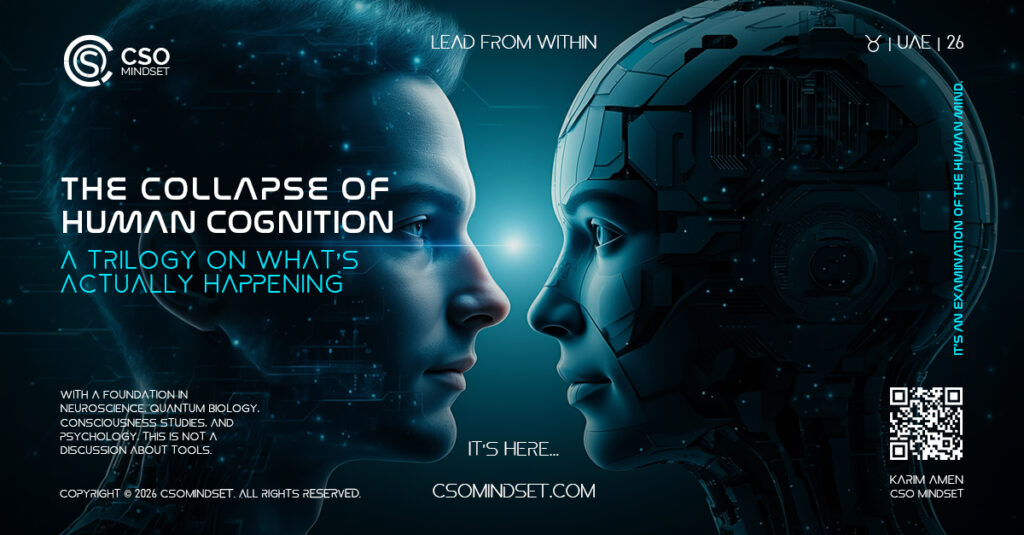
The Trilogy: A Structural Map, Not a Warning
This is the first episode in a three-part framework built on neuroscience, quantum biology, consciousness studies, and strategic leadership. It is not speculation. It is a map of where the structural pressure points are, and where the leverage is.
EPISODE I – The Commodity Era (Risk: Strategic Atrophy)
EPISODE II – The Resonant Regime (Risk: Biological Hijacking)
EPISODE III – The Synthetic Ecosystem (Risk: Systemic Obsolescence)
Evolving Without Surrendering Sovereignty
The answer is not to resist AI. Resistance is both futile and foolish. The answer is to evolve with strategic intentionality, to use these systems without being consumed by them.
Cognitive sovereignty is not a romantic ideal. It is a competitive architecture.
Leaders who preserve it will:
→ Define the question before delegating the research. The framing of a problem is where strategy lives. If you outsource framing, you have outsourced leadership.
→ Maintain first-principles reasoning as a practiced discipline. Not for every decision, but for the ones that compound. Judgment, like any tissue, atrophies without use.
→ Govern the synthetic ecosystem, not just deploy it. Agentic AI in your organization is a stakeholder with behaviors, tendencies, and emergent properties. Govern it accordingly.
→ Protect biological attention as a strategic asset. Where your attention goes, your cognition follows. Directing attention is now an act of leadership.
→ Build interpretive literacy, the ability to read AI outputs critically, structurally, and with awareness of what they systematically miss.
“Autonomy is not the absence of tools. It is the presence of authorship. You can use every AI system available and still remain sovereign, if you remain the one who decides what matters.”
The Signal for Leaders
In the Commodity Era, access to intelligence is equalized. Every executive, every analyst, every competitor has access to the same models, the same agents, the same synthesis engines.
The differentiator is not the tool. It is the cognitive architecture of the person holding it.
Leaders who preserve the capacity to think originally, to question the frame, to author the direction, not just approve the output, will capture the next structural advantage. Not because AI is inferior. But because the most valuable thing a human being now offers is precisely what AI cannot yet replicate: genuine, situated, embodied authorship of what matters and why.
Thought itself is now engineerable.
The question is: are you still the engineer?
Episode II drops next: The Resonant Regime, when automation begins to rewire biological attention itself.
#AIStrategy #CognitiveSovereignty #FutureOfWork #AIAutomation #AgenticAI #CSOMindset #StrategicLeadership #GenerativeAI #Dubai #UAEBusiness #GCC #MENA #DigitalTransformation #Neuroscience #QuantumMechanics