The Market Doesn’t Need More Advice.
It needs better architecture.
For decades, businesses have spent billions on consulting.
PowerPoint presentations.
Strategic reports.
Market analyses.
Transformation roadmaps.
Executive workshops.
Yet despite having more information than ever before, most organizations still struggle to execute.
Why?
Because advice doesn’t build companies.
Systems do.
There is a growing gap between those who talk about business and those who know how to design one.
That gap is where The Business Architect™ was born.
Most Consultants Sell Knowledge.
Business Architects Build Systems.
Knowledge has become abundant.
Artificial Intelligence can summarize books, write strategies, generate presentations, and produce reports within seconds.
Information is no longer the competitive advantage.
Architecture is.
A consultant often answers questions.
A Business Architect designs environments where the right questions, decisions, and actions naturally emerge.
The difference is profound.
One improves ideas.
The other transforms organizations.
What Is a Business Architect?
A Business Architect sees a company as an integrated operating system rather than a collection of departments.
Instead of focusing only on marketing, sales, finance, or operations, they examine how every component interacts.
Business Architecture integrates:
• Strategy
• Leadership
• Organizational Structure
• Business Models
• Operations
• Marketing
• Sales
• Customer Experience
• Finance
• Technology
• Artificial Intelligence
• Data
• Decision Systems
• Organizational Culture
Growth is never accidental.
It is engineered.
Strategy Is Not Slides
Many organizations mistake strategic planning for strategy.
A presentation is not strategy.
A vision statement is not strategy.
A SWOT analysis is not strategy.
Strategy is the disciplined process of making difficult decisions under uncertainty.
It determines:
• Where to compete.
• What not to pursue.
• Which capabilities matter most.
• How resources should be allocated.
• How competitive advantage will be sustained.
Real strategy lives in decisions, not documents.
Execution Is Not Activity
Organizations often confuse movement with progress.
• More meetings.
• More emails.
• More reporting.
• More projects.
None of these guarantee execution.
Execution means converting strategic intent into measurable outcomes.
Every initiative should answer three questions:
- Does it move the organization closer to its strategic objective?
- Can it be measured?
- Can it be repeated consistently?
If the answer is no, it is activity, not execution.
Growth Is Not Luck
Some businesses attribute success to timing.
Others credit market conditions.
Many hope that advertising, hiring, or investment alone will generate sustainable growth.
Growth is rarely accidental.
Scalable organizations build systems that consistently produce value.
Growth emerges when strategy, operations, people, technology, and customer experience reinforce one another.
Businesses don’t scale because they become larger.
They scale because their systems become stronger.
Every Scalable Business Follows a Structure
After studying organizations across multiple industries, one truth becomes clear.
Every enduring business follows a sequence.
Not randomly.
Systematically.
Part One: Shift Your Thinking
Every transformation begins with perspective.
Businesses rarely fail because of insufficient effort.
They fail because they solve the wrong problems.
Architecture begins by changing how leaders think.
Part Two: Define the Real Problem
Symptoms are expensive.
Root causes create leverage.
A Business Architect spends more time defining problems than solving them.
Because correctly identifying the problem often reveals the solution.
Part Three: Understand the Market
Markets are living systems.
Customer behavior changes.
Technology evolves.
Competitors adapt.
Understanding market dynamics becomes a continuous process, not a one-time exercise.
Part Four: Design Strategy
Strategy aligns every organizational capability around one purpose.
It determines:
• Positioning
• Competitive Advantage
• Resource Allocation
• Growth Direction
• Decision Priorities
Without architecture, strategy becomes aspiration.
Part Five: Test Before Scaling
Most businesses scale assumptions.
Architects validate systems first.
They test markets.
Processes.
Pricing.
Customer behavior.
Operational capacity.
Scaling comes after evidence, not before it.
Part Six: Build Growth Systems
Marketing should generate demand.
Sales should convert demand.
Operations should fulfill demand.
Customer success should multiply demand.
Growth becomes predictable when every system supports the next.
Part Seven: Execute and Control
Execution without measurement becomes chaos.
Every scalable organization relies on clear metrics, accountability, and operational discipline.
Execution is not about working harder.
It is about building systems that produce consistent results.
Part Eight: Create Sustainable Competitive Advantage
Products can be copied.
Technology can be replicated.
Pricing can be matched.
Architecture is far more difficult to imitate.
Competitive advantage increasingly comes from how organizations think, learn, and adapt, not simply what they sell.
Part Nine: Final Takeouts
The greatest organizations continuously improve.
They adopt the philosophy of Kaizen.
Small improvements.
Every day.
Across every system.
Excellence becomes habitual rather than exceptional.
Artificial Intelligence Changed the Rules
Artificial Intelligence is changing every function inside the modern enterprise.
Marketing.
Sales.
Finance.
Customer service.
Operations.
Knowledge management.
Decision support.
The organizations that succeed will not simply automate tasks.
They will redesign themselves around intelligence.
Business Architecture provides the framework for that transformation.
Why Business Architecture Matters More Than Ever
Today’s leaders face unprecedented complexity.
Markets evolve faster.
Technology advances continuously.
Customers expect more.
AI accelerates everything.
The challenge is no longer access to information.
It is organizational coherence.
Business Architecture ensures every decision strengthens the entire enterprise rather than optimizing isolated departments.
The Difference Between Consultants and Architects
A consultant may tell you what to improve.
A Business Architect designs a system where improvement becomes inevitable.
Consultants often optimize parts.
Architects optimize the whole.
Consultants solve today’s problems.
Architects build organizations capable of solving tomorrow’s.
That difference determines whether businesses survive, or lead.
Introducing The Business Architect™
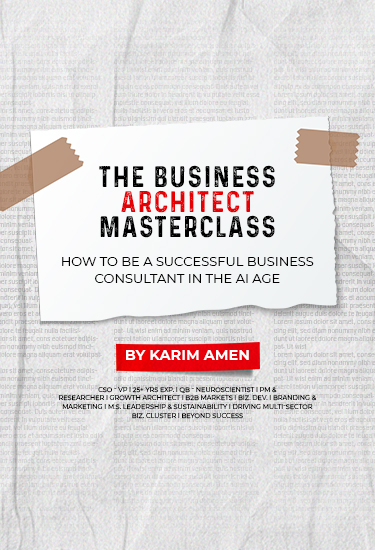
The Business Architect™ is more than a masterclass.
It is a methodology.
A framework.
A way of thinking.
A system for designing organizations that can scale intelligently, adapt continuously, and execute consistently in an era shaped by Artificial Intelligence, complexity, and constant change.
It is designed for:
• Founders
• CEOs
• Executives
• Entrepreneurs
• Consultants
• Investors
• Business Leaders
• Future Organizational Architects
Because the future will not belong to those with the best ideas.
It will belong to those who build the best systems.
Final Thoughts
Businesses do not fail because people lack ambition.
They fail because they lack architecture.
In the coming decade, competitive advantage will not come from having more information.
It will come from designing better systems.
Seeing patterns before others.
Making better decisions under uncertainty.
Building organizations that continue improving long after the founder steps away.
That is the role of the Business Architect.
Not to give advice.
But to design the system behind every scalable business.
About the Author
Karim Amen is a Business Architect, Strategic Growth Leader, and Founder of CSO Mindset™. With more than 25 years of international experience across the USA and MENA, he specializes in Business Architecture, Artificial Intelligence Transformation, Executive Strategy, Organizational Design, and Growth Systems. Through The Business Architect™, Karim helps founders and executives transform complex businesses into intelligent, scalable organizations built for the AI era.
This For: Business Architect, Business Architecture, Business Strategy, Business Growth, Business Consulting, Strategic Planning, Organizational Design, Business Systems, Business Transformation, Executive Leadership, Business Scaling, AI Business Strategy, Growth Strategy, Operational Excellence